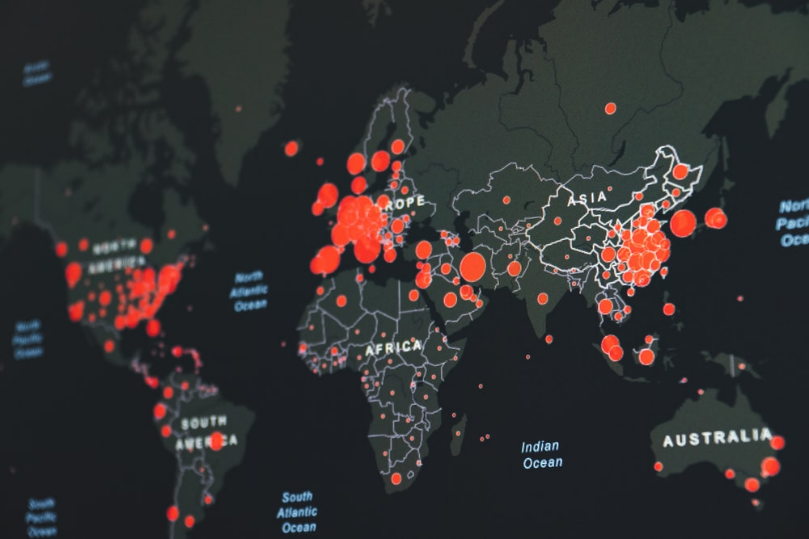
Months after it was detected in China in November of 2019, the COVID-19 pandemic spread across the world to become one of the deadliest in history. While perhaps less lethal than some of the great plagues of history, its global scale was sufficient to hugely disrupt everyday life as almost every country in the world initiated a series of lockdowns and quarantine measures. Like virtually everyone else, civil society was profoundly affected, forced to confront a new reality and a myriad of new challenges. Unlike the great pandemics of the past however, activists of the coronavirus era had access to a wealth of technology which proved indispensable in their many civic endeavors. The Covid-19 pandemic had dramatic and disruptive effects in several areas of customary concern for civil society, including support for vulnerable groups, transparency and government accountability, and education. Yet, with the aid technology including crowdfunding, online support networks, virtual activism, fact checking initiatives, WhatsApp, steaming platforms, and more, civil society supported vulnerable and neglected groups, served as watchdogs for government accountability, and help ensure the continuation of education at a time when the COVID-19 pandemic brought unprecedented challenges in all three areas.
Between 2020 and 2021, virtually no country was left untouched by the COVID-19 pandemic and as such people living under every form of government were impacted. Among countries under ineffectual and/or authoritarian systems, the governments, in turn incompetent or predatory, were rarely in a position to effectively combat the strains caused by the pandemic. In such places, civil society actors were as far as possible already engaged in providing for the most vulnerable sectors of society: the sick, elderly, indigent, and oppressed. With the arrival of COVID-19, many of these already underserviced groups were made even more vulnerable as governments were either unwilling or incapable of seeing to their needs. In these instances, civil society mobilized to fill the gap and technology was central to their reconfigured strategy in light of the limitations produced by lockdowns. Crowdfunding in particular was extensively to address the challenged of caused by lockdowns and ineffective state policy in several countries. In Belarus, experienced civic activists and new volunteers united under the ByCovid19 group and crowdfunded to buy and distribute essential protective and medical equipment to health workers on the frontlines of the fight against the virus, “filling the gaps where their [government] had fallen disgracefully short.”[1] Civic society in other former Soviet states made use of crowdfunding to address similar problems, often pivoting both quickly tactically from their usual area of concern. For example, Tajikistan’s Office of Civil Freedoms, which usually focused on the rights of military conscripts, launched the Help Us Help initiative to provide food and other essential items to those in need. Their crowdfunding campaign was a notable success, raising $2000 (a considerable amount in Tajikistan) within weeks off domestic as well as international donations, all in a cultural context with little tradition of charity donations.[2] In Ukraine, civil society used social media to crowdsource food package and medicine deliveries to the elderly while in Georgia the Help Elders Facebook platform amassed $30,000 to support up to 1,000 seniors with food medicine and other necessities.[3] Outside the former Soviet republics, tech startups in Indonesia stepped in even as the government continued its initial downplaying of the pandemic’s seriousness, crowdfunding both to support informal-sector workers and buy protective equipment for healthcare workers.[4]

Photo by Viki Mohamad on Unsplash
Outside of crowdfunding, civil society actors across the world also made use of online internet networks and computer technology to support vulnerable groups, creating virtual support havens, safe spaces, and informative databases while under quarantine. The India-based group Trust For Youth and Child Leadership International for example, used online art sharing and virtual creativity camps to help vulnerable children in several countries “build resilience, promote creative expression, and provide a safe space for children to interact amidst the COVID-19 pandemic”.[5] In the words of one participant, “With so much going on growing up as a teenager, in addition to COVID-19 and the racial justice movements, this camp really helped my mental health”.[6] Similarly, the Africa-focused Youth Alliance for Leadership and Development in Africa used technology to hold virtual mental stress cafes for African youth, already some of the most at-risk of developing mental health challenges in the aftermath of the pandemic’s disruptions to daily life.[7] “I absolutely love the experience of the Cafe that I attended. What a wonderful way to destress, open up about how you feel, learn from others on how they are managing to stay positive and actually pick up a few practical tips that I am implementing!” said one enthusiastic participant.[8] Still other groups made ingenious use of technology to facilitate the provision of essential pandemic-related services. In Mexico, the Mexican Foundation for Health Civil Association (Funsalud AC) helped the country’s health system manage the strain of COVID-19 hospitalization by launching an online hospital reconversion platform, allowing public medical institutions to devote more resources to treating those infected by the virus while connecting those with other needs to private hospitals capable of providing them free, timely, and efficient care.[9] In Taiwan meanwhile, where civil society was further aided by a highly competent and responsive government, the Taiwanese Digital Minister made possible the collaboration between digital activists and the government within the opensource G0v platform, which led to the design of several free cellphone apps that provided citizens real-time information about both face mask distribution centers and existing stocks of masks.[10]
While some civil society groups recognized the need to step in and help vulnerable groups within their societies, whether to fill the gap left behind by government mishandlings or else to help them respond even more effectively, others groups spotted the equally pressing need to keep the state accountable and society informed during the period of quarantine and restricted movement, especially by more repressive-minded governments looking to take advantage of these measures to further increase their authority beyond the temporal and subjective scope of virus containment. In this area again, technology, especially online communication tools, proved vital. In Malaysia civil society and sectors of the media were vigorous in holding the government to account for their policies and actions during the pandemic, including their attempts to control online expression.[11] According to founder of online news site Malaysiakini, “There were a lot of online activism and push back from the civil society against the government’s policy responses that the later had to retract certain measures”.[12] Meanwhile in Georgia, the Shame civic movement quickly adapted their tactics to a COVID-19 context, holding an online demonstration to protest the governing Georgian Dream party’s backtracking on constitutional amendments and call for a more equitable electoral system, which managed to attract 150,000 views.[13] Beyond pressing for accountability and transparency with their own governments, several civic society actors also used technology to address the equally pressing problem of covid misinformation, which was itself at times directed directly or indirectly by external gov actors. In Taiwan, an effective coronavirus strategy was enacted in spite of the titanic efforts of the propaganda machine in mainland China. The non-profit Taiwan Factcheck Center, set up by communication scholars and activist journalists, countered this by monitoring coordinated inauthentic behaviors online and responding with fact-based clarifications while also cultivating digital media literacy and coordinating with Facebook to take down over sixty accounts for spreading COVID-19 disinformation.[14] The Ukrainian civil society organization Vox Check, whose normal area of work involves fact-checking the speeches of Ukrainian politicians, also partnered with Facebook’s International Fact-Checking network to identify incorrect coronavirus information and provide verified briefings about the pandemic.[15]
Across the globe, the COVID-19 pandemic served a catalyst for civil society actors to employ technology in order to new challenges. Whether crowdfunding to help those most in need or working to pursuing online activism to keep information accurate and governments accountable, the use of technology by civil society reflected the particulars needs and challenges of the countries they worked in. The challenge of sustaining education in the pandemic era however was one which affected virtually every country around the world; quarantines and shutdowns saw schools closed across the globe and millions of children at risk, especially in places where the technological infrastructure was not suitably developed for a mass transition to online learning. Here again, civil society proved adept in several notable cases at making the most effective use of technology within their local environments to address the problem. The closing of schools following India’s nationwide lockdown presented a particular risk for children and youth from slums and poor communities. Reality Gives, a non-profit which helps provide quality education to these at-risk children likewise saw their in-person centers shut down, but, taking into consideration India’s cheap rates for mobile phones as well as their widespread use even among the urban poor, began delivering lessons via WhatsApp.[16] Lessons were further structured around the capabilities of the app itself and followed a “pseudo-live” format rather than being taught in real time, bearing students’ experiences with poor connectivity and dropped calls.[17] Students and teachers participated in daily 1-hour classes “using text, voice notes, videos, and a mark-up feature” with initial feedback from students being very positive.[18] In Lebanon, teachers also used WhatsApp to reach 2000 Syrian refugee and Lebanese children in semi-urban and rural areas through the Lebanese Alternative Learning project.[19] In Colombia, another country faced with an internet infrastructure unable to cope with nationwide remote education, education NGO fellows, alumni and teachers came together to form the A Prender la Onda (ALO), or “switch on the [radio]wave” initiative. In order to support students’ continued learning during the pandemic, ALO designed, recorded and distributed learning audio podcasts through a variety or means including WhatsApp, local radio stations, steaming platforms like Spotify, and even community loudspeakers, again tailoring their approach in acknowledgment of those technologies most available in the local environment.[20] As a 100% teacher-led grassroots solution which directly involved students in the production process, made use of existing resources, and combined different technologies, ALO proved quite innovative,[21] yet in wealthy developed countries like the United States, civil society had to be innovative to meet the challenges of remote education, devising solutions including Wi-Fi buses and strategically spaced government grant-funded hotspots to service communities with poor internet connectivity.[22]

Photo by Aaron Burden on Unsplash
Virtually no corner of the world nor aspect of everyday life has been left untouched by the COVID-19 pandemic. Civil society, like everyone else, was faced with new and unforeseen difficulties in the discharge of their work and activism. Despite this, and arguably for the first time, civil societies in many different countries were able to use technology to meaningfully address the challenges of a pandemic environment. Civil society has often been at the forefront of defending the vulnerable in society, keeping government accountable, securing the universal right to education; technological innovations like crowdfunding, online social networking, virtual activism, and remote learning helped ensure civil society’s continuing ability to so during the COVID-19 pandemic.
[1] Valvoda, Rotislav. ‘Civil Society versus Authoritarians in Eastern Europe and Central Asia.’ Global Civil Society in the Shadow of Coronavirus, edited by Richard Youngs. Carnegie Endowment for International Peace, 2020, pp. 27-30.
[2] ibid
[3] Shapovalova, Natalia. ‘The Coronavirus Crisis as an Opportunity in Ukraine.’ Global Civil Society in the Shadow of Coronavirus, edited by Richard Youngs. Carnegie Endowment for International Peace, 2020, pp. 31-35.; Panchulidze, Elene & Tskitishvili, Mariam. ‘Georgia’s Fight Against the Coronavirus: Fusing State and Societal Resilience’ Global Civil Society in the Shadow of Coronavirus, edited by Richard Youngs. Carnegie Endowment for International Peace, 2020, pp. 37-40.
[4] Lorch, Jasmin & Sombatpoonsiri, Janjira. ‘Southeast Asia Between Autogravitation and Democratic Resurgence.’ Global Civil Society in the Shadow of Coronavirus, edited by Richard Youngs. Carnegie Endowment for International Peace, 2020, pp. 5-10.
[5] ‘Using Creative Arts to Combat Covid-19: A Project from TYCL International.’ End Violence Against Children. September 30, 2020; ‘Virtual Creativity Camp for Positive Mental Health.’ Global Giving.
[6] ‘Using Creative Arts to Combat Covid-19: A Project from TYCL International.’
[7] Njagi, Patricia & Magsino, Geneva. ‘Yalda Launches Youth Stress Management Cafes.’ Yalda Quarterly Newsletter, Volume 2, Issue 2. Youth Alliance for Leadership and Development in Africa, June 2020. pp. 15-16.
[8] ibid
[9] ‘Plan Estratégico Para la Contigencia de Covid-19.’ Fundación Mexicana para la Salud, A.C. pp 1-3.
[10] Ho, Ming-Sho. ‘Watchdogs and Partners: Taiwan’s Civil Society Organizations.’ Global Civil Society in the Shadow of Coronavirus, edited by Richard Youngs. Carnegie Endowment for International Peace, 2020, pp. 11-15.
[11] ‘Stronger alliance of civil society and media in Asia called to fight infodemic.’ Friedrich Naumann Foundation for Freedom. April 16, 2020.
[12] ibid
[13] Panchulidze & Tsitsikashvili
[14] Ho
[15] Shapovalova
[16] Barua, S. and F. Reimers (2020), India: Reality Gives, Education continuity stories series, OECD Publishing, Paris.
[17] ibid
[18] ibid
[19] Maheshwari-Kanoria, J., Zahir, L. and C. Petrie (2021), India, Pakistan, Zambia, Kenya and Lebanon: Education Above All’s Internet Free Education Resource Bank (IFERB), Education continuity stories series, OECD Publishing, Paris.
[20] Please cite this document as: Saenz, M., Medina, A. and Uribe Holguin, B. (2020), Colombia: A prender la Onda (to turn on the wave), Education continuity stories series, OECD Publishing, Paris.
[21] ibid
[22] Forde, Kaelyn. ‘No access: Remote learning widens US digital divide for students.’ Al Jazeera. October 23, 2020; Ladyzhets, Betsy. ‘An Appalachian county kept school Covid cases down with strong community partnerships.’ The Hechinger Report. September 3, 2021.